
At Lemonquest I had thirty people under my direction. Designers, artists, animators, programmers. Every visual decision went through me before being considered final. My job wasn't to draw—although sometimes I did—but to decide. Filter. Say "this yes" and "this no" hundreds of times a day until the project had a coherence you couldn't explain but could feel.
Now, at Dad and Son Games, there are two of us. Alex and me. Father and son. Two generations of gamers trying to build something that matters.
And in some strange way, the art direction work hasn't changed as much as you might expect.
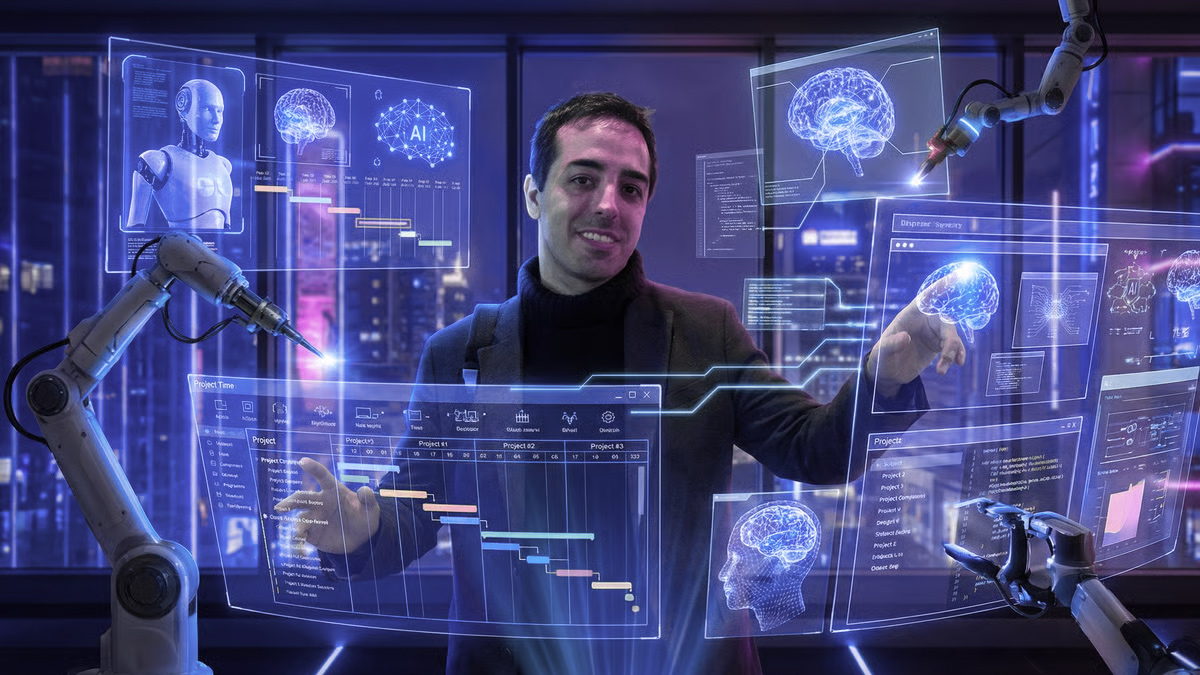
Because now I have another "team" that generates options: AI.
Don't get me wrong. I'm not comparing professional artists with a machine learning model. What I'm saying is that the art director's function—filtering, deciding, maintaining coherence—remains exactly the same, regardless of who or what generates the base material.
When we were working on the visual look of The Bunker, I used AI to explore directions. I generated hundreds of concepts. Literally hundreds. Variations of lighting, color palettes, texture styles, atmospheres. AI doesn't get tired. It doesn't get offended if you ask for another version. It has no ego.
But it also has no judgment.
Of those hundreds of concepts, maybe five had something. A spark. A suggestion of something that could work. The rest was technically competent and completely hollow. Pretty on the surface, empty inside.
My job was still the same as at Lemonquest: identify that five percent that had potential and develop it until it became something real.
The difference is speed. Before, asking an artist to explore ten different directions took days or weeks. Now I can do that initial exploration in hours. But—and this is important—the initial exploration was never the hard part. The hard part has always been knowing what to look for.
I've seen people use AI to generate video game "art" that looks like it came from a generic stock image bank. Technically correct. Visually competent. And absolutely interchangeable with any other game that used the same process without direction.
The problem isn't AI. The problem is not having anything to say.
When I direct art—with humans or with machines—my job is to have a vision clear enough to recognize it when it appears. To know that The Bunker's bunker can't look "generic post-apocalyptic." It has to feel like a space that was designed to protect but has become a trap. The lighting has to suggest claustrophobia without being dark for darkness's sake. The colors have to be muted but not depressing. There's a difference.
AI doesn't know that difference. I know that difference because I've spent decades thinking about how images affect emotions.
Alex brings something I don't have: the perspective of someone who grew up playing, not developing. When I show him visual options, his reactions are those of a player, not a designer. "This looks like a mobile game." "This reminds me of Limbo but without the grace." "This one yes, this one really creeps me out."
That combination—my technical experience and his player instinct—is more valuable than any generation tool.
I use AI in practically all phases of visual development. For initial concepts. For design variations. For exploring palettes. For prototyping assets before deciding if they're worth making "for real." But all of that is working material. Draft. Exploration.
What goes into the final game passes through an exhaustive human filter. It gets adjusted, modified, remade if necessary. Sometimes what comes out of AI is a starting point. Sometimes it's just confirmation of what I don't want.
People talk about AI as if it's going to eliminate the need for art directors. I think the opposite. I think infinite generation makes judgment more necessary, not less. When you can produce a thousand images in an afternoon, the bottleneck isn't production. It's knowing which of those thousand images deserves to exist.
At Lemonquest I learned that directing isn't doing. It's deciding. It's maintaining a coherent vision when twenty people are pulling in twenty different directions.
Now those twenty directions are generated by a machine instead of a team. But the director's function remains the same.
Filter.
Decide.
Stay on course.
Everything else is noise.